
Cherokee County Court Records After Arrest
After an arrest in Cherokee County, the person may be booked into the Cherokee County Adult Detention Center and listed on the JailList maintained by Sheriff Frank Reynolds's office. That jail record can show the booking date, arresting agency, charge text, bond amount or bond status, and holds. The court record begins when the case is filed and tracked through the Clerk of Courts. The two systems can overlap, but they do not serve the same purpose. Booking data answers whether a person is in local custody. Court records answer what has been filed, what court dates exist, who the parties are, and how the case is moving.
For custody and booking facts, use the Cherokee County jail inmate records workflow. For booking-photo questions, use the Cherokee County jail mugshots page. For the court records after a jail arrest, use the Clerk's case search first, then contact or visit the Clerk for the official file. The Clerk warns that online docket access is a convenience and not a substitute for the official file retained by the office.
Search Court Records After Arrest
The key online source is the Cherokee County Clerk of Courts case search page. The Clerk states that users may view dockets by entering the case number, party name, and/or CSE number, then clicking the plus sign beside the case number to view the docket. The case-search page can show overall case posture, including parties, court dates, and judge assignment. Hidden pleadings may contain sensitive data and are blocked from Internet viewing.
- Open the Clerk case search and choose a search path by party name, case number, or CSE number.
- Match the defendant name with any known booking date or charge from the jail roster.
- Click the plus sign next to the case number to view the available docket details.
- Check court dates, judge assignment, filed charge language, and docket entries against the official file when the issue matters.
- Contact or visit the Clerk if the web view omits a pleading, blocks a document, or appears stale.
The source image from the Clerk's case search page shows the local court-search entry point for Cherokee County court records after arrest.
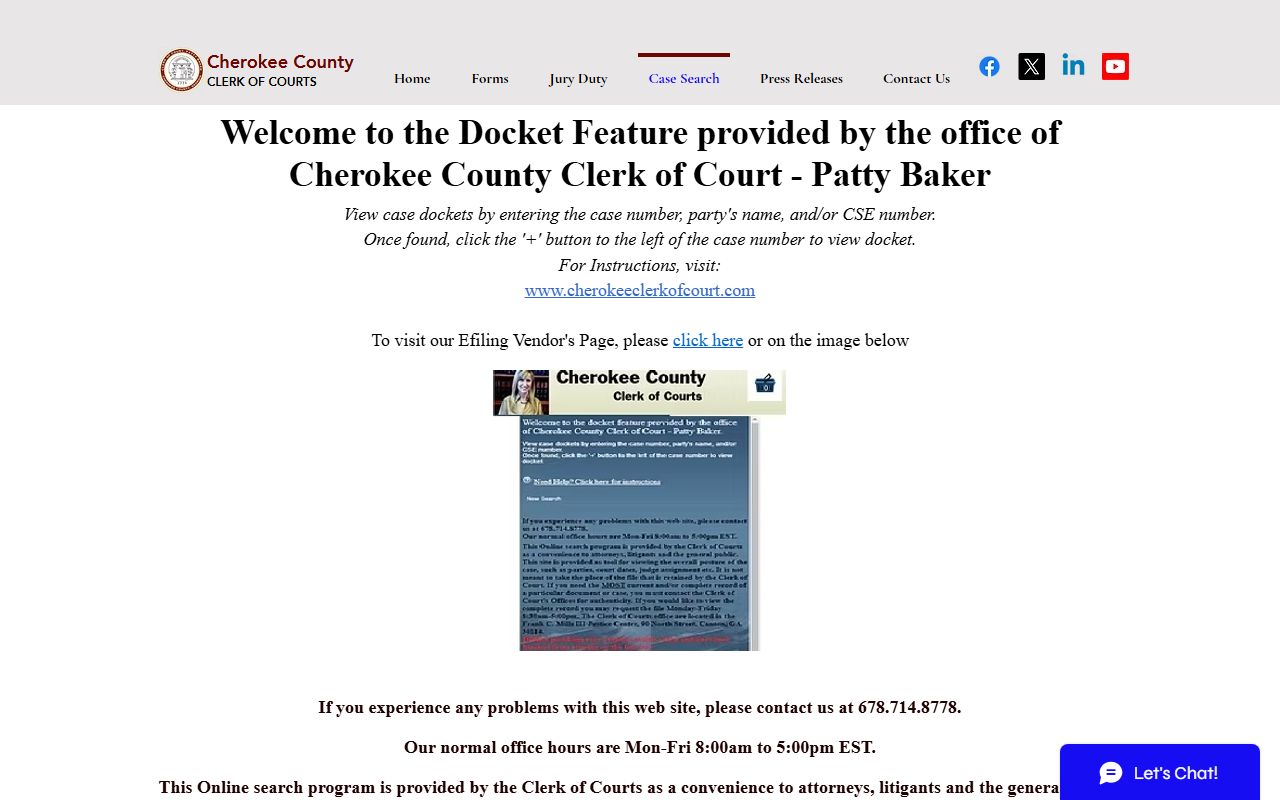
The Clerk page is the court-record source, while the sheriff JailList remains the custody and booking source.
Cherokee County Court Search Fields
The research found three court-search inputs described by the Clerk. These fields are different from the sheriff's JailList, which has a single inmate-name field. A user who knows only the jail charge may need to search by party name first, then compare docket details with booking information.
| Search Field | Type | Use |
|---|---|---|
| Case number | Text | Best when the court case number is already known from a notice, bond document, attorney, or Clerk record. |
| Party name | Text | Best starting point when only the defendant's name is known after a jail arrest. |
| CSE number | Text | A specialized case-search path identified by the Clerk page. |
| Plus sign beside case number | Control | Opens the docket view for the matching case. |
Charges Filed After Arrest
Booking charges and filed court charges may differ. The roster can show an initial charge, warrant reference, failure to appear, probation violation, hold, or bond notation before the court docket has every filing visible online. Prosecutors may add, reduce, amend, dismiss, or replace charges as the case moves forward. Cherokee County prosecution-stage information may also involve the District Attorney for the Blue Ridge Judicial Circuit or related court offices, but filed case copies and docket access route through the Clerk.
| Document | Who Uses It | What It Does |
|---|---|---|
| Complaint | Law enforcement or prosecution path | Sets out an accusation or charge basis early in the case process. |
| Information or accusation | Prosecutor | States charges selected for prosecution without using a grand-jury indictment path. |
| Indictment | Grand jury and prosecutor | Formally charges felony conduct after grand-jury action. |
Georgia case names and document labels can vary by court and charge level. Use the Clerk's file, not a copied roster line, when the exact filed charge controls a deadline, plea, hearing, or background issue.
Cherokee County Charge Status
Court records after an arrest should be read by status, not just by the first charge text. A pending charge is still being handled. A reduced or amended charge has changed from an earlier entry. A dismissed charge is no longer being prosecuted in that form. A conviction requires a plea, verdict, or other final adjudication. The sheriff's own JailList warning says an arrest does not mean conviction, which is the key rule for reading both jail and court records.
| Status | What It Means | Where to Confirm |
|---|---|---|
| Pending | The case or charge is still open and has not reached final disposition. | Clerk docket and official file. |
| Amended or reduced | The filed charge changed from an earlier booking or docket entry. | Clerk filings and prosecutor records where available. |
| Dismissed | The charge is no longer being pursued in that case posture. | Clerk disposition entry or official file. |
| Nolle prosequi | The prosecutor has chosen not to proceed on that charge at that time. | Filed court entry or official case file. |
| Convicted | A plea, verdict, or judgment produced a conviction. | Final disposition and sentencing record. |
Bond After Jail Arrest
Bond information connects the jail record and the court record. The sheriff's Bond Administration page explains that a criminal bond is a financial guarantee that the arrested person will appear in court and that a bond is not a fine. Cash bonds, professional bondsmen, property bonds, and approved property bonds are described by the sheriff. A $20 state-required bond fee is listed for several bond paths, and professional bondsman fees are described under O.C.G.A. 17-6-30.
| Bond Type | How It Works in Cherokee County |
|---|---|
| Cash bond | The full bond amount is paid in cash or cashier's check, with the separate state-required fee paid in exact cash. |
| Debit or credit card bond | The sheriff links to an Allpay path and notes additional non-refundable fees. |
| Professional bond | An approved bondsman posts bond and charges a non-refundable fee set by Georgia law. |
| Property bond | Eligible Cherokee County property may be used if documentation and equity requirements are met. |
| No-bond or agency hold | Release may be blocked by court order, another agency, a warrant, probation issue, ICE hold, or other detainer. |
Bond Administrator questions can route to 678-493-4164. A bond line on the jail roster should still be checked with the jail or court before money is posted because charge and hold status can change.
Cherokee County Prosecution Records
The District Attorney source is relevant after a jail arrest because prosecution choices shape the court record. The Cherokee County District Attorney page identifies Susan K. Treadaway as District Attorney for the Blue Ridge Judicial Circuit. The page links to open records, subpoenas, annual reports, pretrial diversion, a trial calendar, victim services, and special court programs. The DA prosecutes; the Clerk maintains the docket and official court file; the sheriff operates the jail and roster.
The District Attorney source page shows the prosecution office context used for Cherokee County court records after arrest.
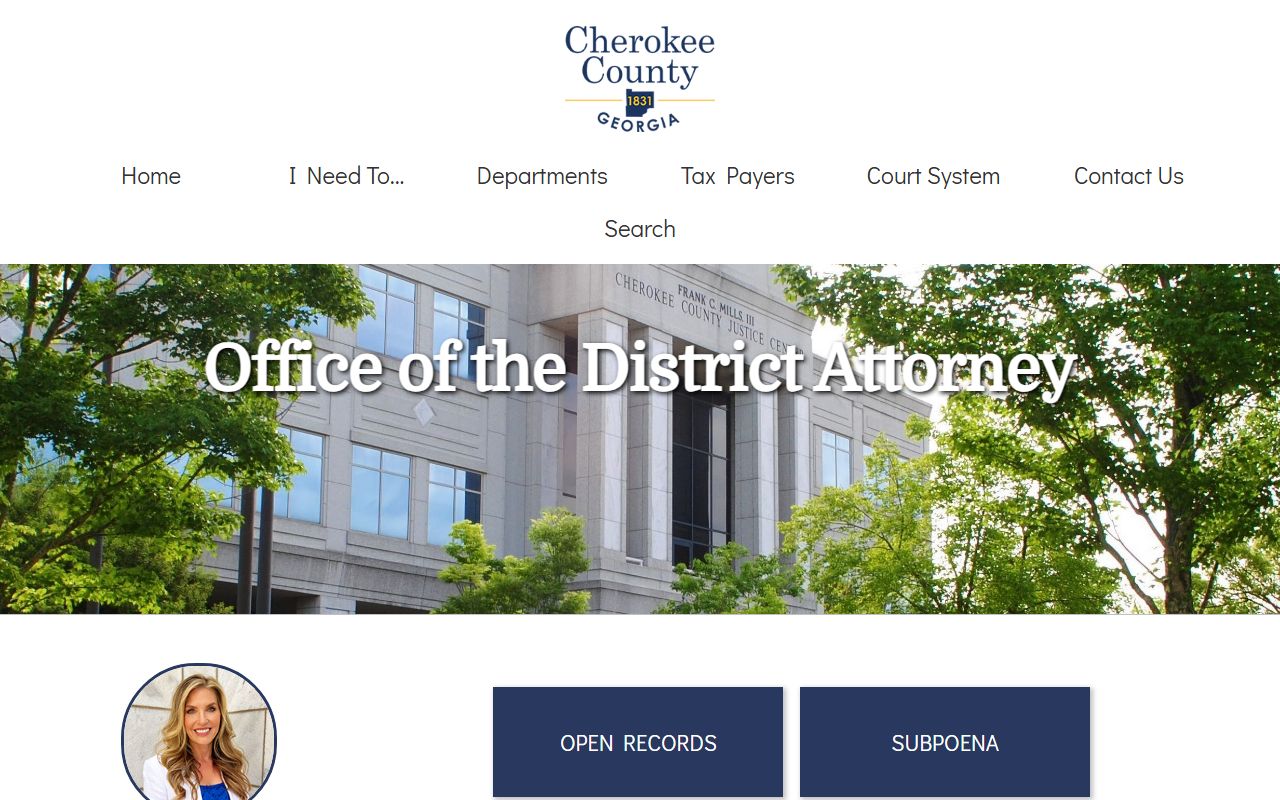
This distinction keeps court-record searches routed to the Clerk while still recognizing the prosecution office's role in filed charges and case programs.
Warrants Before Arrest
The sheriff's Warrants and Civil Unit processes, serves, and maintains local warrants and assists other counties with serving warrants locally. It also places and releases holds with other agencies and arranges felony extraditions from out of state. That work can affect court records after a jail arrest because a booking may be tied to a warrant, failure to appear, probation issue, or other-agency hold rather than a fresh incident alone.
The sheriff warns that the office will not collect or solicit payment for warrants or fines by telephone or any automated service. Treat payment demands by phone as suspect. Court costs, bond, and warrant matters should be checked with the proper court, jail, or sheriff unit through official contact channels.
Charges vs Convictions
A charge is an allegation or filed count. A conviction is the result of a guilty plea, verdict, or other final judgment. Court records after an arrest may show charges for months without showing a conviction. Some charges may be reduced, merged, dismissed, or handled through a diversion path. The difference matters for employment, licensing, housing, immigration, firearms, and sentence questions, but those uses require lawful, source-confirmed records and often legal advice.
| Question | Charge | Conviction |
|---|---|---|
| Case stage | Accusation, warrant, booking, or filed count. | Final result after plea, verdict, or judgment. |
| Proof level | May begin with probable cause or prosecutor filing. | Requires a legal finding or plea resolving the charge. |
| Public record | Often visible, but may be incomplete or restricted. | Usually shown in final disposition records unless restricted by law. |
| Best source | Jail roster, Clerk docket, and filed charging document. | Final court disposition and sentencing record. |
Restricted Arrest Court Records
Georgia uses record restriction language in many contexts where people casually say expungement. The Cherokee Sheriff's Office maintains a criminal record expungement page, and the research identifies O.C.G.A. 35-3-37 as the Georgia record restriction provision to verify before relying on the exact legal text. A restricted record may be hidden from ordinary public access, while other agencies or courts may retain access allowed by law.
| Issue | Sealed or Restricted | Expunged in Common Speech |
|---|---|---|
| Public visibility | Limited from public display when an eligible restriction applies. | Often used by the public to mean removed from normal view. |
| Record existence | The record may still exist for lawful official uses. | Does not always mean physical destruction under Georgia practice. |
| Eligibility | Depends on disposition, offense, timing, and statute. | Must be checked under current Georgia law and court process. |
| Best source | Clerk, sheriff record restriction process, and current Georgia law. | Official court and law-enforcement record channels. |
Important: Do not assume a dismissed charge has disappeared from every database. Confirm restriction status with the agency or court that holds the record.
Cherokee County Official Court File
The Clerk's office is at the Frank C. Mills III Justice Center, 90 North Street, Canton, GA 30114. The case-search page lists normal office hours Monday through Friday, 8:00 a.m. to 5:00 p.m. EST, and says official file requests can be made Monday through Friday, 8:30 a.m. to 5:00 p.m. A problem contact number of 678.714.8778 is listed for the case-search system. The online docket is helpful for orientation, but the complete official file is the control source for court records after a jail arrest.
- Docket
- A chronological case list showing filings, hearings, dates, parties, and court actions.
- Hidden pleading
- A filing blocked from Internet viewing because it may contain sensitive data or restricted content.
- Detainer
- A hold or notice from another agency that can affect release even when local bond appears available.
- Disposition
- The final result of a charge, such as dismissal, plea, verdict, sentence, or other closing entry.
Note: For any deadline, hearing, warrant, bond, or restriction question, rely on the official court or agency record rather than a copied web result.